
The end of the school year brings with it a shift. One that you can feel from your students…and within yourself. If you have yet to engage in meaningful self-reflection, now is the perfect time to begin this practice.
While attending different seminars, as well as keeping up with Pyramid Model training and practices, a focus was made on the practice of self-reflection. Over the past few years, I have looked into ways to be reflective upon my practice as an instructional coach and work to assist teachers in being reflective within their practice as well. This has me asking the question How can ed coaches effectively guide teachers to self-reflect, along with reflecting on our own coaching practices? One year-long seminar I attended had us self-reflect for one hour each Friday. That’s a lot, but setting aside a time to stop and reflect on our lessons, struggles, etc of that week really helped not just in reflection but to plan effectively for the upcoming week. I thought back on the first time I practiced reflection through my classroom cycles as a coach. I found the log I kept for that school year. Here is a short excerpt from my end of year summary on the topic:
This was my first time using the reflective cycle log. At first, my perception was that these logs would be a source of documentation of my time in the classrooms. That the logs would document what was discussed and how I guided and advised the teachers on certain issues. I found it to be very helpful in organizing my classroom times with the teachers. Using this format, I was able to clearly define the purpose for the visit, strengths, needs, follow up notes, and next steps. It allowed me to break down my days in each classroom according to each teacher’s individual needs. Using the reflective logs also helped me in organizing the next steps that needed to occur to allow for growth in that teacher. I noticed rather quickly that the main concerns in the classrooms pertained to student behaviors and the need for structuring transitioning times. This became a running theme among the 3 classrooms that I noted for use in this seminar. The three teachers of these logs are considered novice teachers, having 1 to 3 years classroom teaching experience. All 3 teachers were very receptive to having me in the classroom and giving guidance and suggestions.
Some struggles I found when completing these reflective cycles was that if the teacher was not open to or has never really self-reflected before, it was difficult to get them to the point of doing so. Even when I presented guiding questions, for one teacher, it was difficult to answer through reflection as their responses were always educational catch-phrases and terms to show understanding but not reflection on their own practice.
Reflective practice is a process. I found that there is a level of vulnerability to self-reflection and if we cannot open ourselves to that self-criticism, then we will not elicit true reflective responses that we can learn from. This is one reason why before I enter a classroom for our feedback/reflection portion of our coaching cycle, I write down the questions I want to ask and their order in asking. I also have certain questions that I think may pose that vulnerability to the teacher and provide those questions at the end of our session in written form to complete on their own. This allows the teacher to truly self-reflect without feeling as though I will be critical of their answers. It shouldn’t feel like a test. I found that when beginning the reflection process, it is most effective when given guiding questions but with time alone to respond.
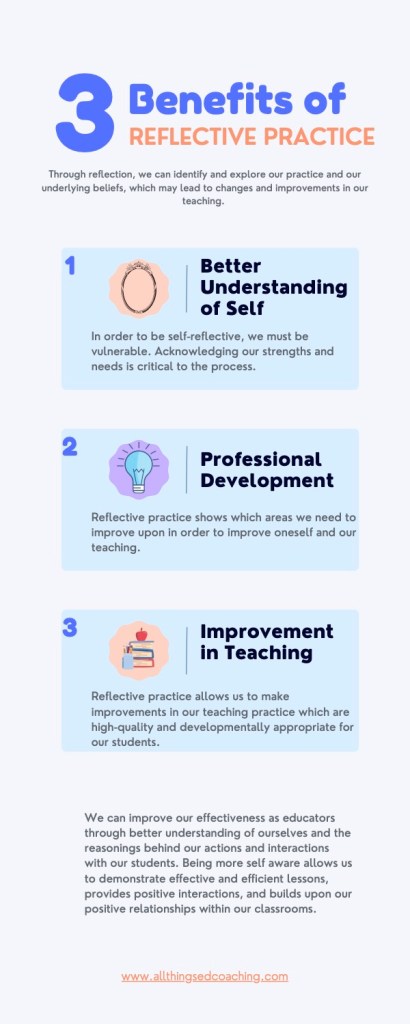
Reflective teaching means that you take a look at what you do within your classroom and think about why you do it. Then, think about whether this works for your students and for yourself. When reflecting, you are evaluating your practices, your responses, and even your reactions. Through reflection, you can identify and explore your practices and find your underlying beliefs. Reflection may lead to changes and improvements in your teaching.
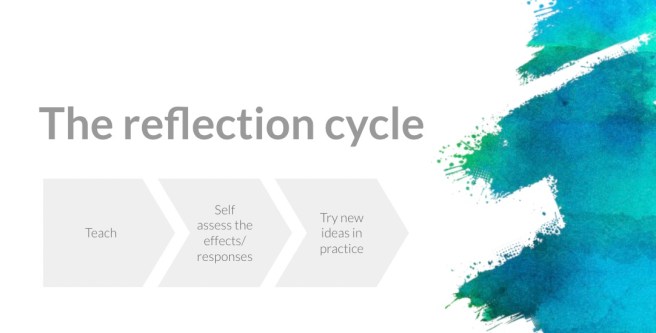
Just as we write anecdotal notes for our students, which is an integral part for educators in early childhood classrooms, we need to take a moment for ourselves. Especially if we feel that the lesson did not go as well as we anticipated or if the response is not what we expected. When reflecting on the responses and outcomes, we really need to make ourselves vulnerable. Even though we may not be sharing our responses with our coaches, we tend to be our toughest critics.
Let’s reflect…
Reflect on the lesson: Was this activity successful or not successful in its goal? What did you like/dislike about this activity?
Reflect on assessment: Does every one of my students benefit from this learning activity? Who did and who did not? What is my reasoning as to why students benefited or not? What methods or activities can I do to establish that my students are learning? What evidence do I have or need? What new strategies can I try later on that might benefit a student that is struggling with this learning activity?
Reflect on classroom management: How many times and when do I give my students opportunities to make their own choices? Would pre-teaching my expectations or developing classroom specific rules and procedures help solve the problems I have in my classroom? Was my attitude towards my class today effective for their learning?
Reflect on my personal professional development: How can I collaborate with my colleagues on lessons and activities to make them more effective? What can I learn from my colleagues? What can I do to help me grow in my practice?
Take-Aways

 All Things Ed Coaching